How a Tube Ice Machine Works: From Water to Hollow Ice Cylinders
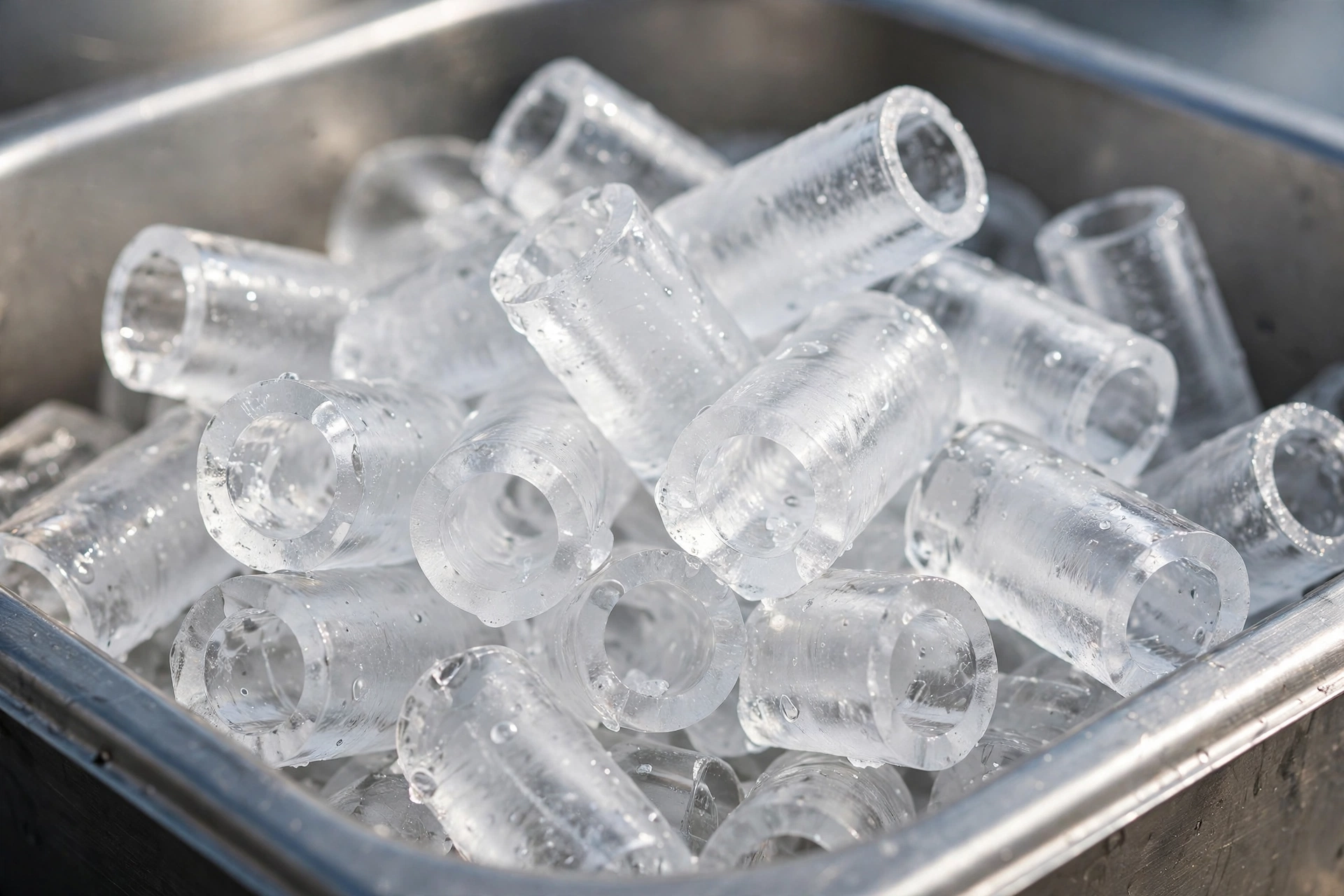
Tube ice is the clear, hollow cylinder you find in bags of edible ice, in drinks at bars and restaurants, and in retail freezers. It looks simple — a short, transparent tube — but the machine that makes it runs a careful cycle of freezing, releasing and cutting, repeated every 15 to 20 minutes. Understanding that cycle helps a buyer judge build quality and keep a plant running at full output.
Unlike flake ice, which is scraped continuously off a cold drum, a tube ice machine works in batches: each cycle freezes a set of ice columns, harvests them, cuts them to length, and starts again — all inside a bank of vertical stainless-steel tubes called the evaporator.
The five parts that do the work
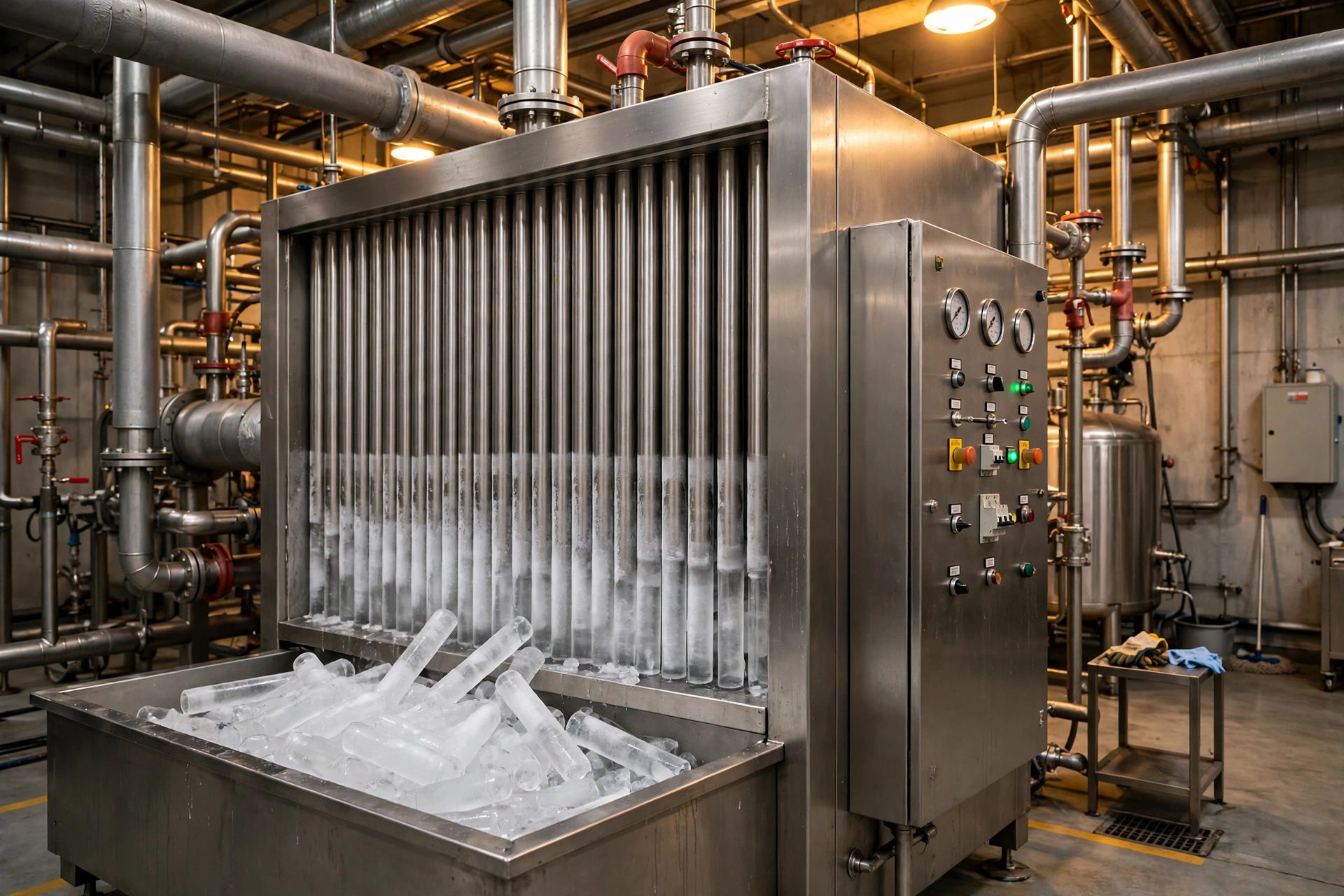
A tube ice machine is built around five systems that work together:
- The evaporator bank. A set of vertical stainless-steel tubes held inside a shell. Water freezes on the inside wall of each tube; refrigerant evaporates on the outside. This is where the ice is actually made.
- The refrigeration system. A compressor, condenser, expansion device and receiver circulate refrigerant, carrying heat away from the water and rejecting it outside the plant room.
- The water circulation system. A pump, tank and distributor at the top of the evaporator spread water evenly over the inner wall of every tube and return the unfrozen water to the tank.
- The control system. A PLC runs the cycle: it controls the water supply, watches freezing time or evaporator pressure, and switches from freezing to harvest at the right moment.
- The harvest and cutting unit. A hot-gas valve and rotary cutter sit below the evaporator: hot gas releases the columns, gravity drops them onto the cutter, and the pieces fall into the storage bin.
Food-grade 304 stainless steel is the standard for every part that touches water or ice — ask which parts are stainless when comparing machines; the answer says a lot about how long it will last in a wet plant room.
The freeze cycle: water becomes a hollow shell
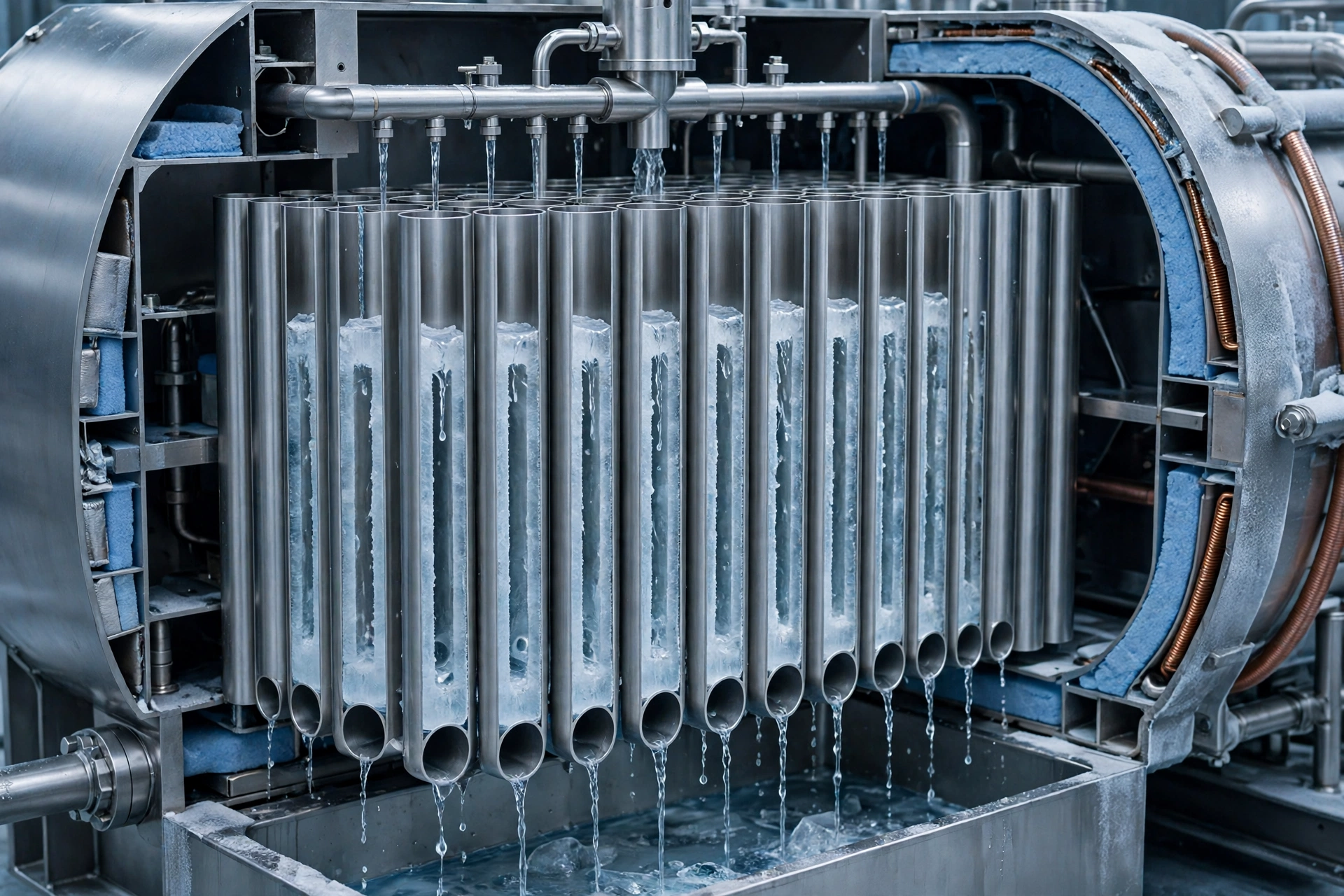
The pump lifts treated water to the evaporator top, where a distributor spreads it in a thin film down the inner wall of each vertical tube. Meanwhile, liquid refrigerant expands into the shell around the outside of the tubes and evaporates, pulling heat through the tube wall.
Ice forms from the wall inward as water keeps flowing down the inside and refrigerant keeps absorbing heat from the outside. The centre stays open because the water there never stops moving — a column of unfrozen water keeps flowing down the middle and back to the tank. That is why the finished product is a hollow cylinder rather than a solid rod.
The freeze continues until the ice wall reaches its set thickness — commonly around 4 to 6 mm, thicker on machines built for longer-lasting ice. A complete cycle typically takes 15 to 20 minutes, depending on inlet water temperature, ambient conditions and the thickness selected.
The purest water freezes first, so as the layer grows, dissolved solids are washed down into the sump and flushed out during harvest. The result is clear ice with a clean taste — one reason tube ice is the standard for edible ice. Water treatment before the machine (filtration and softening where needed) still matters: it protects the tubes from scale and keeps the ice clear.
The harvest: hot gas, gravity and a rotary cutter
Once the ice reaches its thickness, the water supply stops and a valve redirects hot, high-pressure refrigerant gas from the compressor discharge into the evaporator shell. The gas warms the tube walls just past freezing point — only a thin outer skin needs to melt. Within a few minutes the columns loosen and slide down under their own weight.
Below the evaporator, the long columns land on a rotating cutter that slices them into short, uniform pieces, commonly 25 to 50 mm long. Common diameters are around 22, 28 and 35 mm, and most machines let the buyer choose diameter and cut length — shorter pieces for drinks, longer ones for bagged retail ice. The finished pieces drop into an insulated storage bin or cold room, ready for bagging or loading.
Some designs use warm water on the outside of the tubes as well as, or instead of, hot gas — useful where the supply water is warm. Either way, the principle is the same: a brief, controlled warming that frees the ice without melting much of it, keeping the harvest fast and energy-efficient.
Why the hollow shape matters
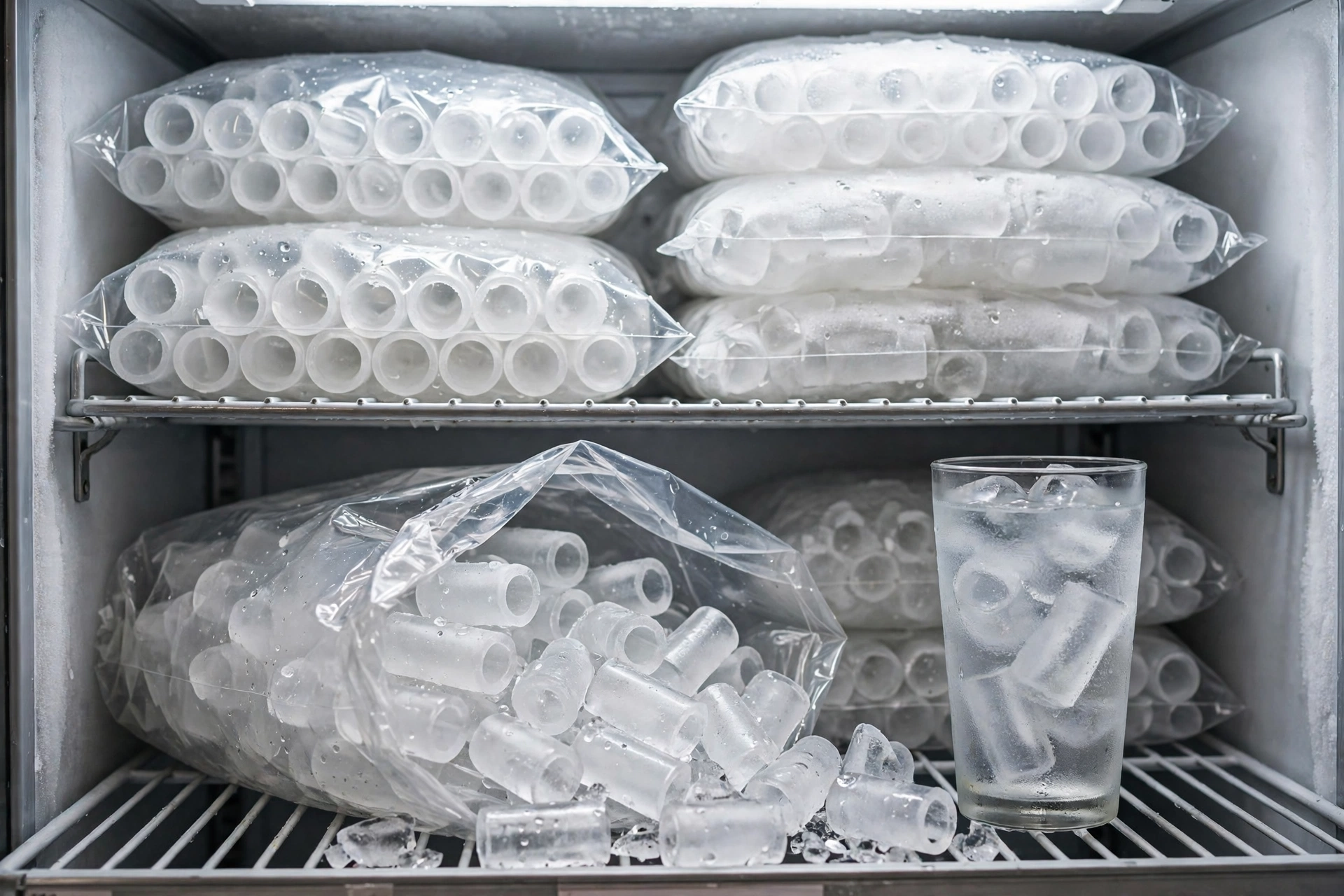
The hollow centre is not a gimmick. It gives tube ice three practical advantages:
- It cools fast. The hollow core and thin wall give each piece a large surface area for its weight, so it chills a drink quickly — faster than a solid block of the same weight.
- It looks clean. Slow, layer-by-layer freezing and the washing effect of the circulating water produce transparent ice with a hard, dry surface — and customers buying bagged edible ice judge quality by appearance first.
- It melts predictably. Uniform wall thickness means pieces melt at a similar rate, unlike irregular crushed ice — useful for portion control in bars and cafés.
Against that, tube ice melts faster than block ice, so it is not the best choice for long transport without refrigeration or for keeping a fish hold cold for days — our comparison of tube, flake, block and cube ice explains which type suits each use.
What affects output and ice quality
Rated capacity is measured under defined test conditions, so output on your own site depends on a few factors worth checking before you buy:
- Inlet water temperature. Warmer water adds heat that must be removed before freezing starts, lengthening every cycle and cutting daily output. Measure your water temperature in the hottest season, not the coolest.
- Ambient temperature and ventilation. A hot, poorly ventilated plant room raises condensing pressure and slows the refrigeration circuit.
- Water quality. Hard or dirty water leaves scale on the tube walls, insulating them, slowing freezing and clouding the ice. Treat the water and clean the tubes on schedule.
- Harvest timing. A controller that harvests too early makes thin, fragile ice; one that harvests too late wastes energy and time on ice that is thicker than the customer needs. Ask how the machine decides when to harvest — by time, by pressure, or by ice thickness.
Daily output is the number of cycles multiplied by the ice per cycle, so anything that shortens the cycle or keeps it consistent — cold feed water, clean tubes, a well-ventilated condenser — shows up directly as more tons per day. If you are sizing a machine, our guide to calculating the capacity you actually need walks through the formula, including the hot-climate correction.
The bottom line
A tube ice machine freezes water in a thin layer on the inside of vertical tubes, releases the hollow columns with a short burst of hot gas, and cuts them to length with a rotary cutter — repeating the cycle every 15 to 20 minutes. The details decide the result: even water distribution, clean tubes, correct harvest timing and good water treatment are what separate clear, uniform ice from cloudy, uneven pieces.
Nineyan builds tube ice machines from 1 to 20 tons per day, in a range of tube diameters and cut lengths. Tell us your daily demand, water conditions and the ice size your market wants for a recommended configuration: dina@nineyantech.com or WhatsApp +86 18819008672.