How to Calculate the Ice Machine Capacity You Actually Need
An ice machine that is too small means lost sales on your busiest days and customers who go to a competitor. One that is too big means money tied up in equipment you never fully use, plus electricity spent cooling capacity you do not need. Getting the size right is the most valuable decision in an ice plant project — and it starts with your own demand, not with a product catalogue.
Industrial ice machines are rated in tons per 24 hours: one ton means 1,000 kilograms of ice produced in a full day of continuous running. That number hides three questions you have to answer first: how much ice do you use on your busiest day, how many hours will the machine really run, and how much output will your climate take away? This guide works through each one, with a formula you can apply to your own numbers.
Start with demand, not the catalogue

Before comparing machines, measure how much ice your business consumes. Collect 7 to 14 days of real figures — sales records if you sell ice, usage logs if you use it yourself — and pick out the highest realistic day, not a quiet weekday average. Sizing from an average guarantees a shortage at the worst moment: the peak of summer, a festival weekend, or the biggest catch of the season.
Break demand into its separate uses, because each one behaves differently:
- Ice you sell, for example bagged tube ice to shops and restaurants, or blocks sold to fishermen and market vendors.
- Ice you consume in your own process, such as flake ice for chilling seafood, meat or concrete. A seafood processor often uses roughly 1 to 1.5 kilograms of ice per kilogram of fish, depending on climate and handling.
- Ice lost in handling and transport is real demand even though nobody pays for it: melting during loading, storage and delivery typically adds 5 to 10 percent on top of what you sell or use.
If you are starting a new business and have no records yet, work from the other end: how many customers or how much product will you serve per day, and how much ice does each one need? Rough numbers are fine at this stage — the formula below has safety margins built in precisely because early estimates are uncertain.
The sizing formula, step by step
Once you know your baseline, the calculation has five steps:
Required capacity = peak daily demand × (1 + handling losses) ÷ operating-hours factor ÷ derating factor
- Baseline daily demand. Your average daily ice use or sales in kilograms, from your records or your estimate.
- Peak factor. Multiply by a seasonal peak factor for your busiest period:
| Business type | Typical peak factor |
|---|---|
| Hotel, restaurant or café with steady demand | 1.15–1.25 |
| Bagged ice retail and beverage supply | 1.25–1.40 |
| Seafood processing and fishing | 1.30–1.50 |
| Event venues and highly seasonal trade | 1.40–1.60 |
- Handling losses. Add 5 to 10 percent for melting and handling — more if ice travels far or sits in warm conditions.
- Operating-hours factor. A machine rated per 24 hours only delivers that figure if it runs around the clock. If yours runs 20 hours a day, divide by 20 ÷ 24 (0.83). On a single 12-hour shift, divide by 0.5 — you need a machine rated at twice your daily demand.
- Derating factor. In hot climates, divide by 0.80 to 0.95 to allow for the output a warm site takes away (see below).
Finally, add a modest reserve of 15 to 25 percent above the result if your sales data is thin or you expect growth in the next year or two. It is far cheaper than adding a second machine later.
Why the nameplate number is not your real output
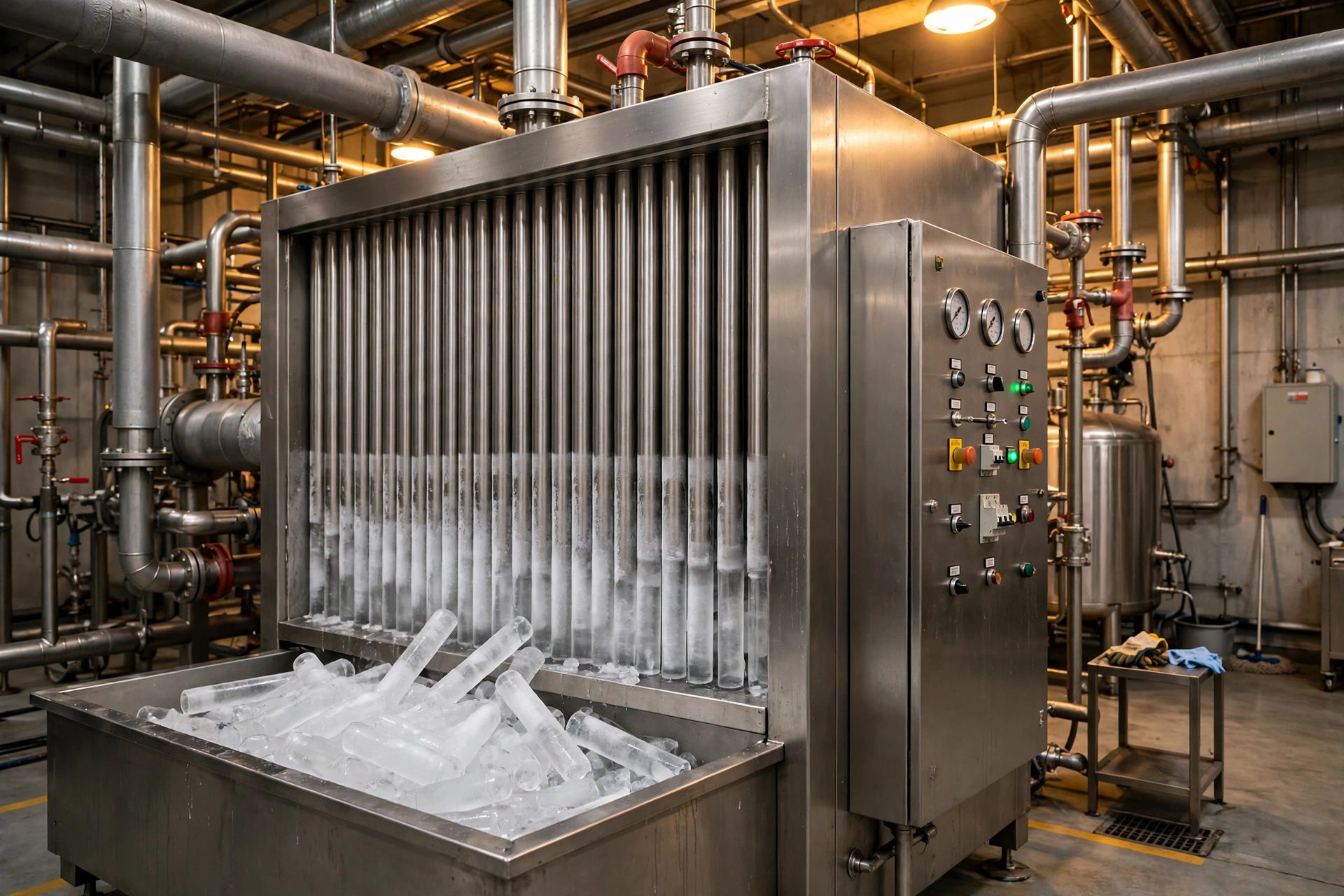
A catalogue rating is measured under defined test conditions — commonly around 21 °C ambient air and 10 °C inlet water. Few real sites match those conditions: in a tropical plant room the air can exceed 35 °C, and supply water in summer is often above 25 °C, which raises the refrigeration load, lengthens the freezing cycle, and cuts daily output below the nameplate figure.
Four site factors matter most:
- Ambient temperature. Air-cooled machines lose capacity as the room gets hotter, and a poorly ventilated plant room can run far hotter than the building around it.
- Inlet water temperature. Warmer feed water means more heat to remove before freezing starts — measure it in the hottest season, not winter.
- Ventilation and condenser condition. Hot air trapped around the condenser, or a dirty coil, has the same effect as a hotter climate.
- Voltage stability. Where the grid is unstable, low voltage can cut compressor performance and interrupt production.
So always ask the manufacturer what the machine will produce at your actual site conditions — ambient temperature, water temperature, operating hours — rather than comparing catalogue figures alone. A supplier who can give you that derated number is giving you a usable answer; one who cannot is asking you to gamble. If you are comparing ice types as well as sizes, our guide to tube, flake, block and cube ice explains which ice suits each application.
Size storage to match production
Capacity and storage solve different problems. Production covers the day's total volume; storage covers peaks within the day — the morning rush when fishing boats load up, or the evening surge when shops restock. A machine that makes enough ice in 24 hours still fails if there is nowhere to hold it when customers arrive together.
Keep one to two days of peak sales in storage, and size the bin with a simple check: take the largest short-term demand you expect, subtract what the machine produces during that period, and add a reserve for delays. Block ice stores well because it melts slowly; flake ice needs a well-insulated cold room because its large surface area melts faster. Storage is part of the capacity decision, not an afterthought — an undersized bin forces the machine to stop, and every stop is lost production.
A worked example: a bagged ice business
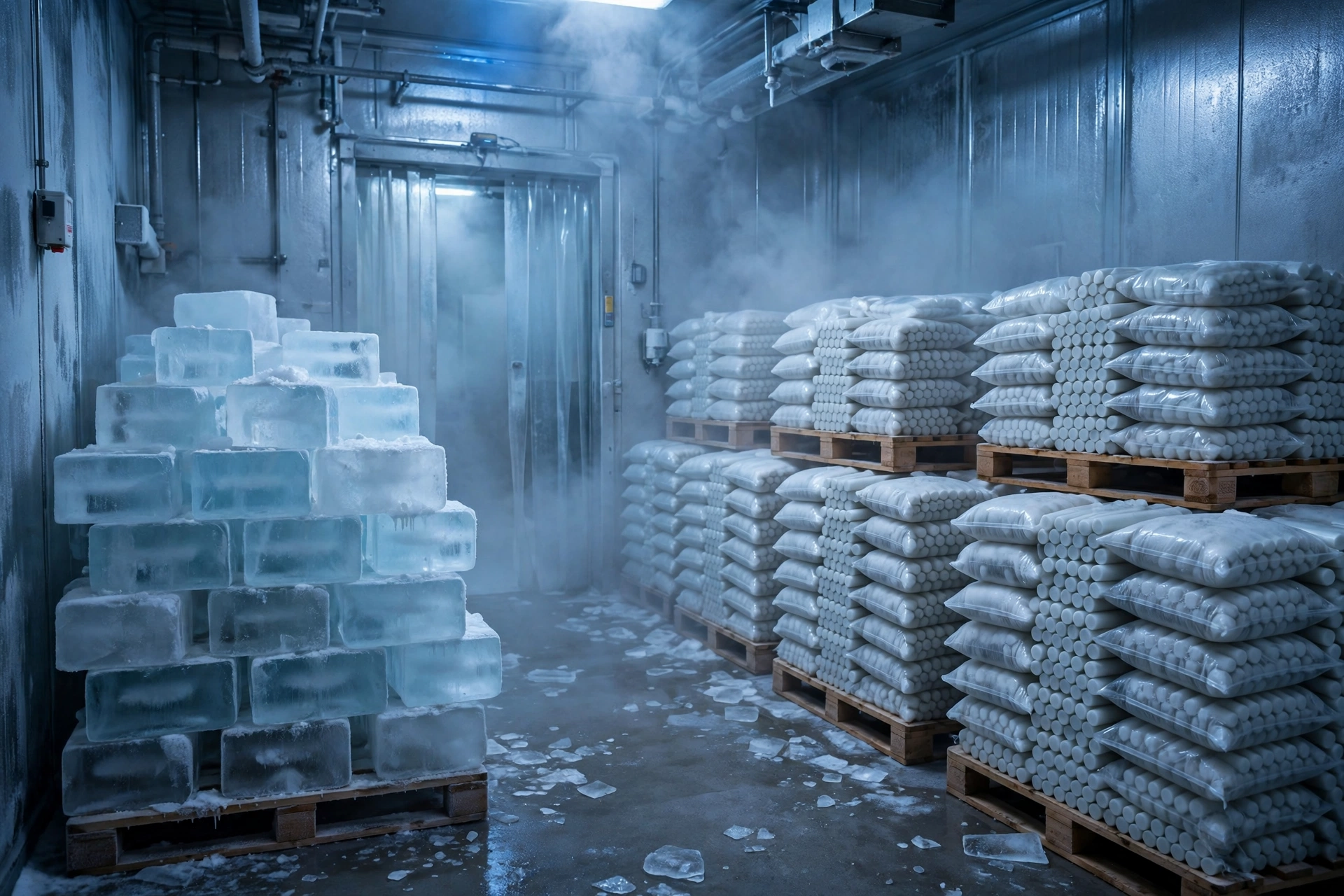
Put the formula to work for a bagged tube ice business in a hot climate:
- Average sales: 3,000 kg per day.
- Peak factor: 1.3 for the summer season → 3,000 × 1.3 = 3,900 kg of peak daily demand.
- Handling losses: 5 percent → 3,900 × 1.05 = 4,095 kg.
- Operating hours: the plant runs 20 hours a day, so divide by 20 ÷ 24 (0.83) → 4,095 ÷ 0.83 ≈ 4,930 kg.
- Derating: a hot site factor of 0.85 → 4,930 ÷ 0.85 ≈ 5,800 kg.
So a 6-ton machine is the right choice — not the 3-ton machine the average sales figure suggested, and not a 10-ton machine either. Storage to match would be roughly 1.5 days of peak sales, or about 6 tons of cold storage. Each step corrected the first naive answer; skipping any one of them is how undersized plants happen.
The bottom line
Size from your busiest day, not your average one. Apply a peak factor, add handling losses, then correct for real running hours and what your climate takes off the catalogue rating. Finally, size storage to the same peak day. A machine chosen this way runs steadily, covers the summer rush, and leaves room to grow.
Nineyan builds tube, flake, block and cube ice machines from 1 to 20 tons per day. Share your daily demand, peak season and site conditions, and we will work through this calculation with you and recommend a configuration: dina@nineyantech.com or WhatsApp +86 18819008672.